
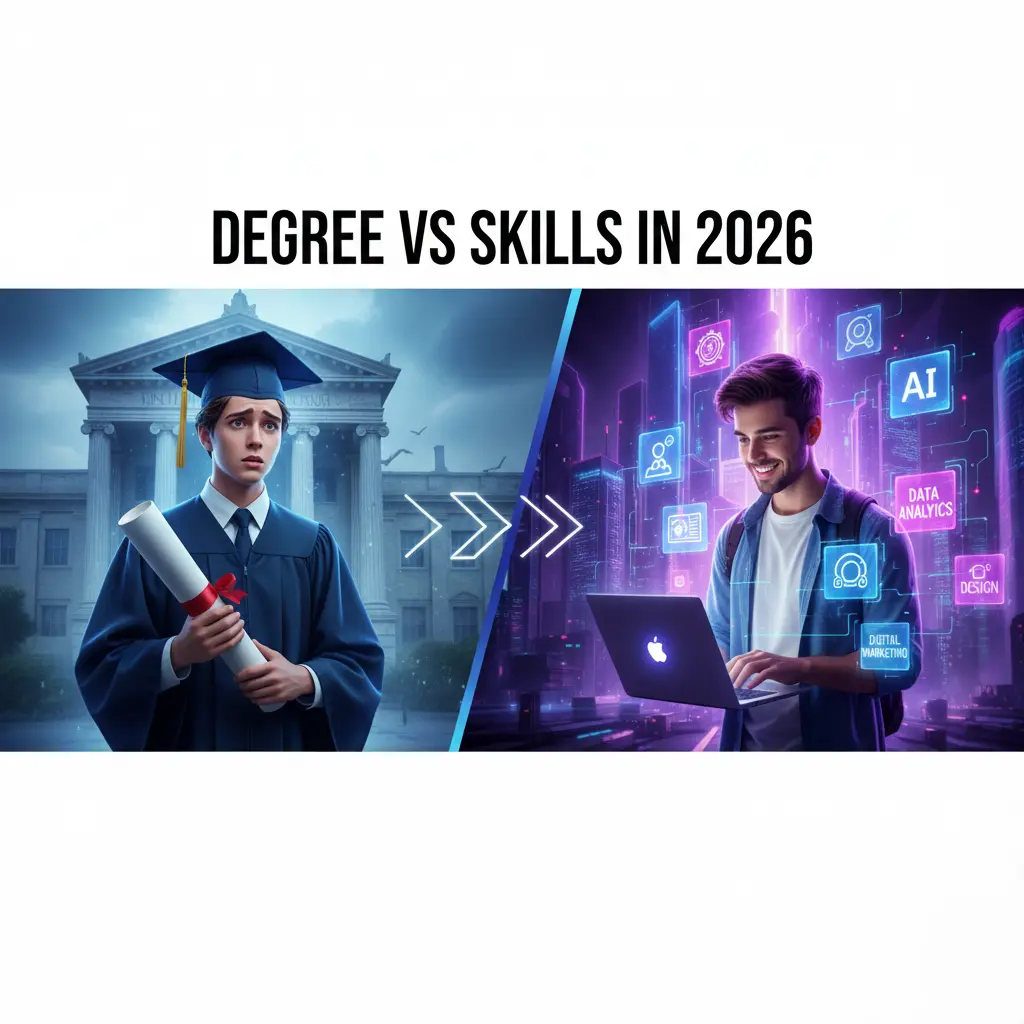
The job market is evolving faster than ever. Automation, AI tools, remote work, and project-based hiring have transformed how companies evaluate candidates. The long-standing debate of Degree vs skills has become more relevant in 2026, as employers shift focus from credentials to capabilities.
If you are a student, working professional, or career switcher, understanding what truly matters today can help you make smarter decisions for your future.
Why the Debate Around Degree vs Skills Is Growing
For decades, a college degree was considered the golden ticket to a stable career. Universities were seen as the primary pathway to success. However, the rise of technology, online learning platforms, and industry certifications has changed this narrative.
Today, recruiters are asking a different question: “Can you do the job?” instead of “Where did you study?”
The conversation around Degree vs skills has intensified because many companies now prioritize practical experience, real-world projects, and measurable results over formal qualifications.
At the same time, degrees still carry value in many industries. So the real question isn’t about choosing one over the other, but understanding how each plays a role in 2026.
The Value of a Degree in 2026
A formal degree still offers several advantages:
1. Structured Learning
Universities provide systematic education and foundational knowledge. Fields like medicine, law, engineering, and academia still require degrees as mandatory qualifications.
2. Credibility and Screening
Large organizations often use degrees as an initial screening tool. It simplifies shortlisting when thousands of candidates apply.
3. Networking Opportunities
Colleges provide alumni networks, internships, and exposure that can open doors early in your career.
However, a degree alone is no longer enough. In the debate of Degree vs skills, employers increasingly expect candidates to demonstrate practical expertise beyond academic theory.
The Rise of Skills in 2026
The future belongs to those who can adapt quickly. Technical abilities, digital literacy, communication, and problem-solving are becoming essential across industries.
1. Skill-Based Hiring Is Increasing
Many global tech companies have removed strict degree requirements for certain roles. Instead, they assess:
1. Portfolio work
2. Certifications
3. Live assignments
4. Problem-solving tests
This shift clearly strengthens the case in the Degree vs skills discussion.
2. Government and National Initiatives
Countries like India are actively promoting skill development. Programs like Skill India focus on vocational training and industry-ready capabilities. These initiatives aim to make youth employment-ready without depending solely on traditional academic degrees.
Such movements highlight how practical competencies are becoming central to employment strategies.
3. Faster Learning Cycles
In 2026, technology changes every few months. University curricula often struggle to keep pace. Skill-based courses, bootcamps, and micro-certifications update more rapidly, aligning closely with industry needs.
This flexibility plays a major role in shifting the balance in the Degree vs skills comparison.
Skills in 2026 That Employers Prioritize
When we talk about Skills in 2026, employers are looking for a blend of technical and human abilities.
Technical Skills
5. Artificial Intelligence and automation tools
6. Data analysis and visualization
7. Cybersecurity awareness
8. Digital marketing and content strategy
9. Cloud computing
Soft Skills
10. Critical thinking
11. Adaptability
12. Communication
13. Leadership
14. Collaboration in remote teams
Companies now value professionals who continuously upgrade their abilities. In many cases, candidates who can prove strong competencies outperform degree holders without hands-on experience.
When Degree vs Skills Becomes a False Choice
The truth is, the debate of Degree vs skills should not always be seen as a battle. The most successful professionals in 2026 combine both.
A degree can provide theoretical depth and credibility, while skills provide execution power. Employers ideally want candidates who understand concepts and can apply them effectively.
For example:
15. A computer science graduate with real coding projects stands out.
16. A marketing professional with certifications and campaign results becomes more competitive.
17. An engineer with AI tool expertise becomes future-ready.
Instead of asking which one is better, the smarter question is how to align your education with practical application.
How to Stay Competitive in 2026
If you are planning your career, here’s how to approach the Degree vs skills decision strategically:
1. Research Your Industry
Some fields still require formal education. Others prioritize demonstrable work.
2. Build a Portfolio
Show real-world projects. Employers trust evidence more than claims.
3. Keep Learning
Upskill regularly through short courses, workshops, and certifications.
4. Focus on Employability
Understand what companies expect under the evolving landscape of Skills in 2026 and tailor your development accordingly.